Youth in Modern Society
In many societies today, we often notice a powerful contradiction. Young people are more connected, informed, and energetic than any generation before them. At the same time, they appear anxious, uncertain, and deeply pressured. From everyday observations, it becomes clear that being young in the modern world is not as simple as it looks.
Youth is not only an age group. It is a force. Across history, youth have questioned injustice, challenged outdated systems, and opened new paths for society. From freedom movements to social reforms, young minds have always played a central role. Even today, whether in developed nations or developing regions, youth remain the driving energy of change.
Yet, youth in modern society face a complex reality—one shaped by opportunity and struggle at the same time.
Understanding Youth Beyond Geography
Youth challenges are often discussed country by country, but many issues cross borders. A young student in Europe, a job-seeker in Africa, a college graduate in Asia, or a working youth in Latin America may live in different conditions, yet they share similar concerns.
Education pressure. Employment uncertainty. Mental stress. Identity confusion. Digital overload.
The problems may appear in different forms, but their roots are surprisingly similar. This is why youth in modern society must be understood from a global perspective, not a limited national one.
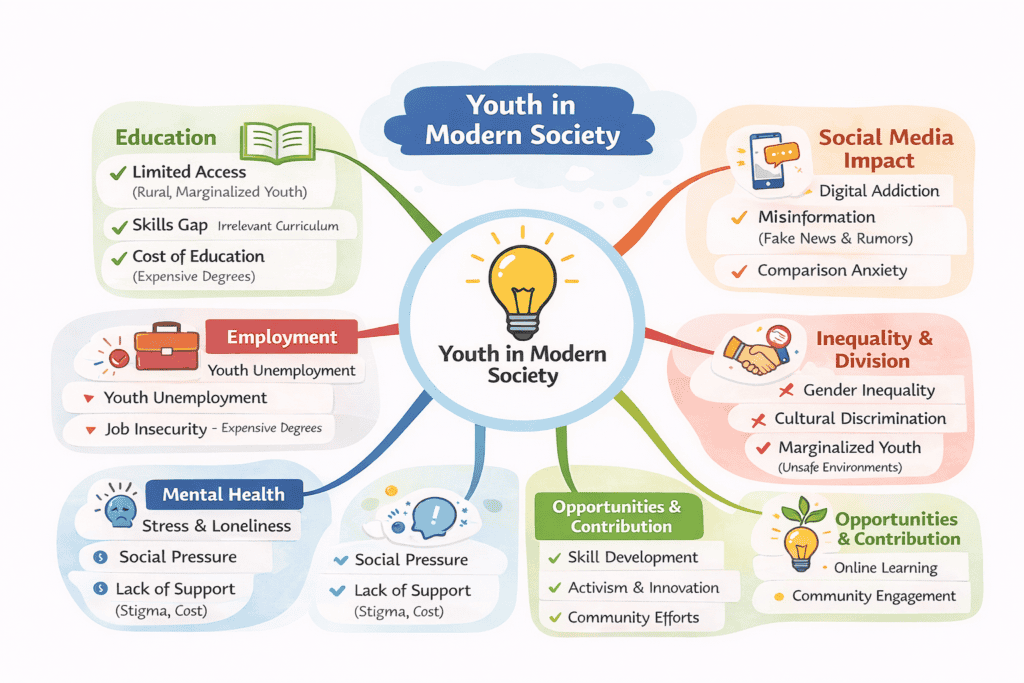
Education: Access, Quality, and Relevance
Education remains one of the biggest concerns for youth worldwide. In some countries, access to education is still limited. In others, education is available but expensive. In many places, the problem is relevance.
Young people often spend years earning degrees that do not prepare them for real-life work. Skills demanded by the modern economy change faster than education systems. This gap creates frustration and self-doubt.
In developing countries, rural and marginalized youth face additional barriers—lack of infrastructure, internet access, trained teachers, and learning resources. In developed nations, student debt and competitive pressure create a different kind of burden.
Education, instead of becoming a path to confidence, often becomes a source of anxiety.
Employment and Economic Uncertainty
Employment is closely tied to dignity and independence. Yet youth unemployment is a global issue. Even qualified young people struggle to find stable jobs.
In many regions, work is temporary, insecure, and poorly paid. The fear of instability affects long-term planning—family, housing, and personal growth. For youth in poorer nations, the challenge is often survival. For youth in wealthier nations, it is purpose and security.
Economic inequality deepens this divide. A small section of youth enjoys opportunities, while a large number feel left behind. This imbalance creates social tension and emotional stress.
Mental Health: A Silent Global Crisis
Youth mental health has become one of the most serious issues in modern society. Stress, loneliness, comparison, and constant performance pressure affect young people everywhere.
A simple real-life example is youth stress linked to expectations. Many young people feel they must succeed quickly—career, money, lifestyle—all at once. When reality does not match these expectations, disappointment turns inward.
Urban loneliness is another growing concern. Even in crowded cities, many youth feel emotionally isolated. Digital connection often replaces human connection, but it does not fully satisfy emotional needs.
Despite growing awareness, mental health support remains inadequate in many countries. Stigma, cost, and lack of services prevent youth from seeking help.
Social Media and Digital Pressure
Social media has given youth a global voice. It spreads ideas, awareness, and creativity. But it also brings serious challenges.
Social media addiction affects attention, sleep, and self-esteem. Constant comparison creates unrealistic standards of success and beauty. Misinformation spreads faster than truth, shaping opinions without understanding.
Youth in modern society often live between two worlds—the online image and the offline reality. Balancing these worlds is not easy, and many struggle quietly.
Inequality and Social Division
Youth experience inequality in many forms—economic, social, gender-based, and cultural. In some societies, gender inequality still limits young women’s freedom and choices. In others, racial or ethnic discrimination affects youth identity and opportunity.
Marginalized youth often face multiple disadvantages at once. Limited education, poor health services, unsafe environments, and lack of representation push them further away from progress.
This sense of exclusion sometimes leads youth toward frustration, anger, or destructive paths. Rising crime rates and social unrest in many regions are connected to unmet youth needs.
Youth as Agents of Change
Despite challenges, youth are not passive victims. Across the world, young people are actively shaping solutions.
Youth-led movements for climate action, social justice, education reform, and digital inclusion show strong responsibility. Many young people engage in volunteering, community work, and social entrepreneurship.
They are creating start-ups, learning new skills, and adapting faster than systems around them. This proves that youth in modern society are not lacking ability—they are often lacking support and direction.
Opportunities Through Skill and Awareness
One positive shift is the growing focus on skill development. Online learning, digital tools, and global exposure allow youth to learn beyond traditional classrooms.
Young people are increasingly aware of social responsibility. They care about sustainability, equality, and ethical living. This awareness, when guided properly, can transform societies.
The key lies in aligning youth energy with opportunity—education that matches reality, employment that respects dignity, and mental health support that understands human complexity.
Conclusion: One Youth, One Future
From everyday observations, it becomes clear that youth across the world share more similarities than differences. Language, culture, and geography may change, but hopes and fears remain deeply human.
Youth in modern society stand at a critical point. If supported with understanding, opportunity, and trust, they can reshape tomorrow’s world. If ignored, their frustration can weaken social foundations.
The youth of today are not just facing challenges—they are preparing the ground for a more humane future. When guided with empathy and vision, youth can transform today’s struggles into tomorrow’s solutions.
A society that invests in its youth does not merely secure its future—it humanizes it.
And perhaps, the youth of today, united beyond borders, will create a world where progress is measured not only by growth, but by dignity, balance, and shared humanity.
Frequently Asked Questions (FAQs)
1. Who are considered youth in today’s global society?
In today’s global society, youth usually refer to people between the ages of 15 and 35. However, youth is not just about age—it also reflects energy, ideas, adaptability, and the willingness to question and improve society.
2. What are the biggest problems faced by youth worldwide?
Youth across the world face challenges such as unemployment, unequal access to education, mental health stress, social inequality, digital pressure, and uncertainty about the future. These problems exist in both developed and developing countries, though in different forms.
3. How does social media affect today’s youth?
Social media helps young people connect and express themselves, but it also creates pressure, comparison, misinformation, and addiction. Many youths struggle with anxiety and loneliness due to constant online exposure.
4. Why is mental health a growing concern among youth?
Mental health issues are increasing due to academic pressure, job insecurity, social expectations, and isolation. In many societies, mental health is still not openly discussed, which makes it harder for youth to seek help.
5. Are youth only affected by problems, or do they also create solutions?
Youth are not just facing problems—they are also leading solutions. Across the world, young people are working in education, climate action, social innovation, community service, and digital development.
6. How are youth in developed and developing countries different?
Youth in developing countries often struggle with basic resources like education and jobs, while youth in developed countries face issues such as loneliness, mental stress, and identity pressure. Despite these differences, the emotional challenges are surprisingly similar.
7. What role can youth play in shaping the future?
Youth play a critical role in shaping a more human, inclusive, and sustainable future. Their ideas, creativity, and courage help societies adapt to change and solve long-term problems.
8. How can societies better support today’s youth?
Societies can support youth by improving education quality, creating fair job opportunities, providing mental health support, encouraging critical thinking, and including youth voices in decision-making.