
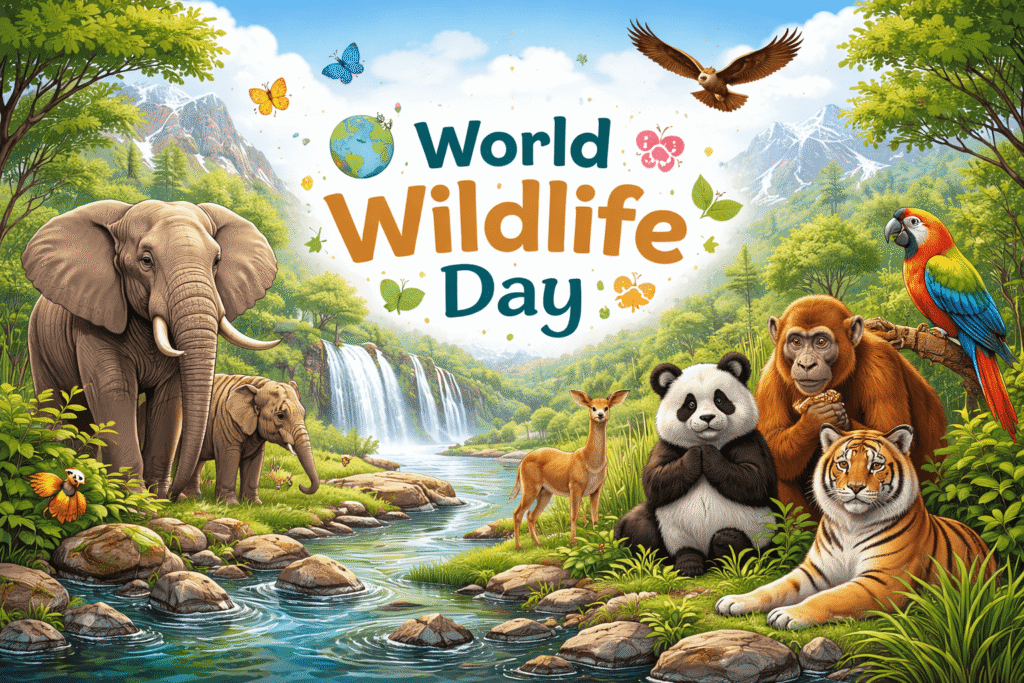
What is World Wildlife Day and why does it matter today?
World Wildlife Day is observed every year on March 3 to celebrate the beauty, value, and importance of wild animals and plants across the world. In simple words, this day reminds humanity that wildlife is not separate from us — it is connected to our survival, our health, and our future.
World Wildlife Day is not just about posting pictures of lions, elephants or forests on social media. It is about understanding that biodiversity — meaning the variety of life on Earth — keeps our planet balanced. Forests give oxygen. Bees pollinate crops. Rivers support fish and farming. Medicinal plants heal diseases. Without wildlife, life becomes unstable.
Today, wildlife is under serious pressure. Habitat destruction, pollution, climate change, illegal wildlife trade, and overuse of natural resources are causing species to disappear faster than ever. That is why World Wildlife Day has become more important in recent years.
How did World Wildlife Day begin?
World Wildlife Day was officially declared by the United Nations General Assembly in 2013. The date March 3 was selected because it marks the anniversary of the signing of Convention on International Trade in Endangered Species of Wild Fauna and Flora in 1973.
CITES is an international agreement between governments. Its purpose is to ensure that international trade in wild animals and plants does not threaten their survival. Over time, countries realized that wildlife protection needed more public awareness. So March 3 became a global observance.
The idea behind starting World Wildlife Day was simple but powerful — bring wildlife conservation into mainstream discussion. Not only scientists, but students, farmers, policymakers, businesses and families should understand its importance.
Why was World Wildlife Day really started?
The real reason behind starting World Wildlife Day was concern. Wildlife populations were declining at alarming rates. Many species were becoming endangered due to illegal hunting, habitat loss and commercial exploitation.
Governments and environmental experts saw that conservation laws alone were not enough. People needed awareness. Communities needed involvement. Youth needed education. Without public participation, wildlife protection cannot succeed.
World Wildlife Day was therefore started to:
- Raise global awareness
- Promote sustainable use of natural resources
- Encourage international cooperation
- Highlight endangered species
- Support biodiversity conservation
In short, it was started to remind humanity that protecting wildlife is protecting ourselves.
What is the theme of World Wildlife Day 2026?
Every year World Wildlife Day highlights a specific theme. The theme guides discussions and global campaigns.
The 2026 theme focuses on “Medicinal and Aromatic Plants: Conserving Health, Heritage and Livelihoods.”
This theme draws attention to plants that are used for traditional medicine, modern pharmaceuticals, and local income generation. Across Asia, Africa and Latin America, millions of people depend on medicinal plants for primary healthcare.
However, overharvesting and habitat destruction are putting these plants at risk. If these species disappear, traditional knowledge and local livelihoods will also suffer.
So the 2026 theme connects wildlife conservation directly with human health and economic stability.
Which organisations are engaged in World Wildlife Day?
World Wildlife Day is globally coordinated by the CITES Secretariat under the United Nations system. Various international and local organizations actively participate.
Organizations such as the World Wildlife Fund and the International Fund for Animal Welfare conduct awareness campaigns, youth contests, conservation projects and research initiatives.
Government forest departments, universities, wildlife research institutes and NGOs also organize events like:
- Educational seminars
- Wildlife photography exhibitions
- Tree plantation drives
- Biodiversity awareness programs
This collective effort makes World Wildlife Day a truly global movement.
How does World Wildlife Day create global impact?
The global impact of World Wildlife Day can be seen in several ways.
First, it increases media coverage of wildlife issues. News channels, blogs, and social platforms discuss conservation challenges and success stories.
Second, governments sometimes announce new wildlife protection policies or conservation projects around this day. Protected areas are expanded. Anti-poaching measures are strengthened.
Third, funding and partnerships for conservation increase because awareness leads to support.
Most importantly, the day creates emotional connection. When people understand that wildlife is part of their culture and survival, they care more.
Why is wildlife important for human life?
Wildlife plays a critical role in maintaining ecological balance. Predators control prey populations. Pollinators help crops grow. Forest ecosystems regulate climate and rainfall patterns.
If wildlife disappears:
- Food chains collapse
- Soil fertility reduces
- Water sources degrade
- Climate becomes unstable
For example, bees are small insects but they support agriculture worldwide. If pollinators decline, food production declines. That directly affects human life.
Medicinal plants provide ingredients for many modern medicines. Losing biodiversity means losing future medical discoveries.
So wildlife conservation is not luxury — it is necessity.
How are youth involved in World Wildlife Day?
Youth involvement is a strong pillar of World Wildlife Day. Young people are encouraged to participate through:
- Wildlife art competitions
- Social media campaigns
- Nature clubs
- Environmental education programs
Many schools organize awareness rallies and eco-club activities. Students learn about endangered species and sustainable living.
Young minds are powerful because they question, innovate and act. If youth understand biodiversity importance early, they grow into responsible citizens.
What are the biggest threats facing wildlife today?
Wildlife today faces multiple serious threats.
Habitat destruction due to urban expansion and agriculture is one of the biggest issues. Forests are cleared for roads, buildings and farming.
Illegal wildlife trade is another major threat. Animals are hunted for skin, bones, meat or exotic pet markets.
Climate change is altering habitats. Rising temperatures affect migration patterns and breeding cycles.
Pollution — plastic in oceans, chemicals in rivers — harms marine and land species.
World Wildlife Day highlights these threats so that governments and citizens take preventive steps.
How can ordinary people contribute to wildlife protection?
Protecting wildlife is not only government responsibility. Every individual can help.
People can reduce plastic use, support eco-friendly products, and avoid items made from endangered species.
Participating in local conservation activities such as tree planting or river cleanups makes real difference.
Educating children about nature creates long-term change.
Even simple actions like saving water and electricity indirectly protect ecosystems.
World Wildlife Day reminds us that small daily actions matter.
How does World Wildlife Day support sustainable development?
Sustainable development means meeting present needs without harming future generations. Wildlife conservation is directly linked with this idea.
Healthy ecosystems provide economic benefits through tourism, fisheries, agriculture and medicine.
If natural systems collapse, economies suffer.
Therefore, World Wildlife Day supports sustainable development by encouraging responsible resource use and biodiversity protection.
What makes World Wildlife Day unique among global observances?
Many international days exist, but World Wildlife Day is unique because it connects environment, economy, culture and health together.
It is not limited to one country or species. It covers forests, oceans, deserts, mountains — all ecosystems.
The focus is both emotional and scientific. It combines policy discussions with public participation.
Its uniqueness lies in its universal relevance. Every human depends on wildlife in some form.
What is the long-term vision of World Wildlife Day?
The long-term vision of World Wildlife Day is a world where humans and wildlife coexist in harmony.
This vision includes:
- Reduced illegal wildlife trade
- Restored ecosystems
- Protected endangered species
- Strong environmental education
- Community-based conservation
If global cooperation continues, biodiversity loss can be slowed and reversed.
Conclusion: Why must World Wildlife Day become a daily responsibility?
World Wildlife Day is more than a celebration. It is a reminder of responsibility.
Wildlife is not only about animals in jungles. It is about forests giving oxygen, rivers providing water, plants healing diseases and ecosystems supporting life.
Protecting wildlife means protecting human dignity and survival.
If we act wisely today, future generations will inherit a rich, balanced and beautiful planet. If we ignore the warning signs, the loss may be permanent.
World Wildlife Day teaches one clear message — nature does not need us, but we absolutely need nature.
FAQ Section – World Wildlife Day
What is World Wildlife Day?
World Wildlife Day is observed every year on March 3 to celebrate wild animals and plants and to raise awareness about biodiversity conservation. It reminds people that protecting wildlife is essential for ecological balance and human survival.
Why is World Wildlife Day celebrated on March 3?
World Wildlife Day is celebrated on March 3 because on this date in 1973 the Convention on International Trade in Endangered Species (CITES) was signed. This agreement helps regulate international trade of endangered species.
Who declared World Wildlife Day?
World Wildlife Day was officially declared in 2013 by the United Nations General Assembly to promote global awareness about wildlife protection and sustainable development.
What is the theme of World Wildlife Day 2026?
The theme of World Wildlife Day 2026 focuses on “Medicinal and Aromatic Plants: Conserving Health, Heritage and Livelihoods.” The theme highlights the importance of plant biodiversity for healthcare systems and local communities.
Why is wildlife important for human life?
Wildlife supports food systems, climate balance, medicine, pollination and clean water. Without biodiversity, ecosystems become unstable, directly affecting human health and economic security.
How can students participate in World Wildlife Day?
Students can participate by organizing awareness campaigns, joining eco-clubs, planting trees, creating wildlife art, and learning about endangered species. Youth involvement is essential for long-term conservation success.
How does World Wildlife Day help in wildlife conservation?
World Wildlife Day spreads awareness, influences policy decisions, encourages global cooperation, and motivates communities to take part in conservation efforts.