Introduction
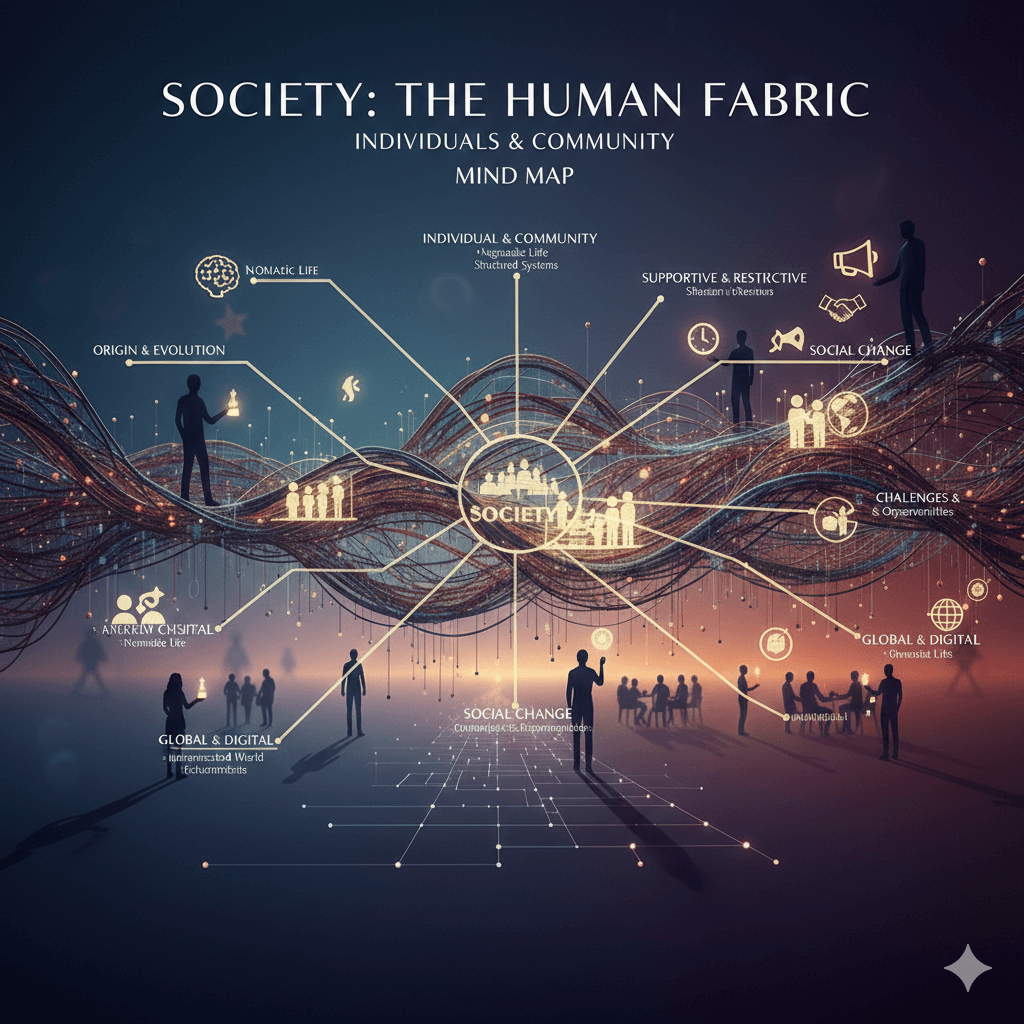
What Is Society?-Meaning, Evolution, and the Role of Individuals in a Changing World If we look at human history carefully, one thing becomes very clear — human life has never existed in isolation. From the earliest tribes to today’s digital communities, society has shaped how we think, live, work, and relate to one another. Society is not just a crowd of people living in the same place. It is a living system made of relationships, shared values, traditions, rules, and institutions.
We are born into society before we even understand what it is. It gives us language, culture, identity, and structure. At the same time, we also shape society through our actions, ideas, and struggles. The relationship between society and the individual is continuous and dynamic. One cannot exist meaningfully without the other.
This article explores the origin of society, its development, the relationship between individual and community, social change, and the ongoing challenges societies face globally.
The Origin of Society: From Survival to Structure
In early human history, people lived as nomads. They moved constantly in search of food and shelter. Life revolved around hunting and gathering. There were no permanent settlements, no formal institutions, and no structured social systems as we understand them today.
A major turning point came with the discovery of agriculture. When humans learned to grow crops and domesticate animals, they began settling in one place. This stability led to the formation of families, property ownership, cooperation, and eventually organized communities.
Agriculture did more than provide food. It created interdependence. People began relying on one another for survival and productivity. Over time, this interdependence evolved into structured social systems — what we now call society.
Sociologist Émile Durkheim described this transformation as the movement from “mechanical solidarity” (simple societies with shared similarities) to “organic solidarity” (complex societies based on interdependence). His ideas still help us understand how society grows more complex over time.
The Evolution of Society Across Time
Society has never remained fixed. It changes with time, technology, culture, economics, and politics. Ancient societies were based on kinship and tradition. Medieval societies revolved around religion and monarchy. Industrial societies introduced factories, urbanization, and capitalism. Today, we live in a digital and global society shaped by technology and rapid communication.
Each stage brought progress, but also conflict. Industrialization created economic growth but also inequality. Globalization connected countries but also created cultural tensions. Social media connects billions of people, yet loneliness remains a serious issue.
Change, however, is the natural character of society. Sociologist Karl Marx viewed society as constantly shaped by conflict between different groups, especially economic classes. While his ideas are debated, his central insight remains relevant — societies transform through tension and adaptation.
Society: Both Supportive and Restrictive
Society can be a source of security, belonging, and opportunity. It gives individuals protection, identity, and access to education and healthcare. Without society, survival itself would be difficult.
At the same time, society can also impose pressure. Social expectations, discrimination, inequality, and rigid traditions sometimes limit personal freedom. Many individuals feel judged or restricted by social norms.
This dual nature of society — supportive yet restrictive — has always existed. French sociologist Pierre Bourdieu explained how social structures influence opportunities through what he called “social capital” and “cultural capital.” Not everyone begins life with equal access to resources or influence.
Understanding this balance is important. Society is not entirely good or entirely flawed. It reflects both the strengths and weaknesses of human behavior.
The Relationship Between Individual and Society
One of the most debated questions in sociology is: Does society shape the individual, or does the individual shape society?
The truth is more balanced. Individuals are born into existing systems — family structures, cultural norms, economic conditions. These systems influence their thinking and choices. However, individuals also challenge, reform, and reshape society.
History shows countless examples. Social reformers like Mahatma Gandhi, Martin Luther King Jr., and Nelson Mandela did not accept society as it was. They questioned injustice and inspired collective change. Their actions transformed social systems at national and global levels.
Sociologist Anthony Giddens proposed the theory of “structuration,” explaining that society and individuals constantly influence each other. Structures shape people, but people also reproduce or change those structures.
In simple words, society and individuals grow together.
The Core Principles Behind the Formation of Society
There are a few fundamental truths about society:
- Human beings are social by nature.
- Society is created by humans, not imposed by nature.
- The primary purpose of society is collective survival and development.
Every society function through a combination of written laws and unwritten norms. These norms guide behavior — respect, cooperation, fairness, and responsibility. When individuals follow these shared values, society remains stable.
At the same time, when norms become outdated or unjust, reform becomes necessary. A healthy society must remain flexible.
Social Change and Revolutions
Throughout history, people have challenged social systems during times of crisis. Revolutions often arise when inequality becomes extreme or when voices remain unheard.
The French Revolution, the American Civil Rights Movement, and anti-colonial struggles across Asia and Africa all represent moments when societies demanded transformation.
However, an important pattern appears repeatedly: the new system that replaces the old eventually becomes part of society itself. Change does not end society — it reshapes it.
Social change is not always dramatic. Sometimes it happens gradually through education, awareness, and dialogue. Gender equality movements, environmental awareness campaigns, and digital activism are examples of modern social transformation.
Modern Society: Global and Interconnected
Today’s society is global. Events in one country affect others instantly. Economic markets are interconnected. Climate change is a shared concern. Migration and technology blur cultural boundaries.
Global institutions such as the United Nations, World Health Organization, and international human rights organizations reflect this interconnected reality.
Yet global society also faces challenges: economic inequality, political polarization, environmental degradation, and social fragmentation.
Sociologist Zygmunt Bauman described modern society as “liquid modernity,” where change is constant and stability feels temporary. Relationships, careers, and identities shift quickly. This fluidity creates both opportunity and uncertainty.
Social Problems and Collective Responsibility
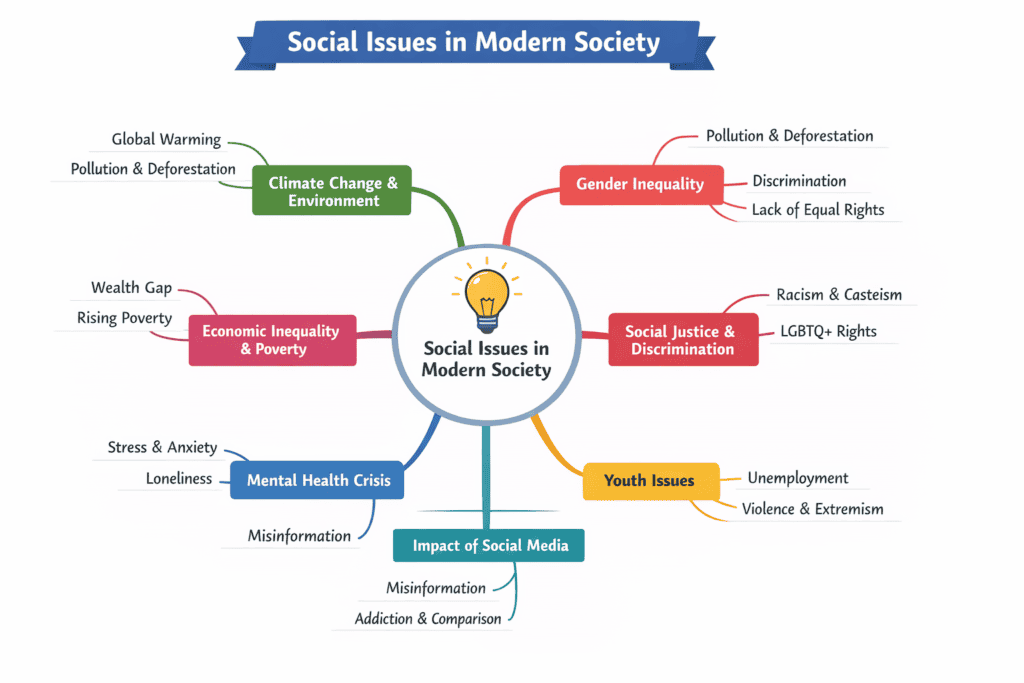
Where there is society, there are social problems. Poverty, inequality, discrimination, violence, and corruption have existed in various forms across civilizations.
However, the presence of problems also means the possibility of solutions.
Education remains one of the strongest tools for social improvement. Awareness reduces prejudice. Dialogue prevents conflict. Inclusive policies promote fairness.
Research from global development studies consistently shows that societies investing in education, healthcare, and equal opportunity experience long-term stability and growth.
The responsibility does not lie only with governments. Citizens, communities, educators, and institutions all play a role in shaping healthier societies.
The Responsibility of Society in the 21st Century
In today’s fast-changing world, society must prioritize:
- Equal access to education
- Economic fairness
- Gender equality
- Environmental sustainability
- Digital responsibility
If society becomes rigid and resists adaptation, it may hinder individual progress. On the other hand, if it evolves thoughtfully, it can create space for innovation and well-being.
Modern democratic systems are built on the idea that citizens participate in shaping society. Public dialogue, civic engagement, and responsible leadership are essential.
Society and the Future
No society is perfect. No individual is flawless. The strength of society lies not in perfection but in its ability to reform and grow.
Future societies will likely be even more technologically advanced and globally connected. Artificial intelligence, climate policies, and demographic changes will redefine social structures.
But the core principle will remain the same: human beings need connection, cooperation, and shared purpose.
Society is not an enemy of the individual. It is a shared journey.
Conclusion
What Is Society – Society is an ever-moving cycle. It begins with human interaction and continues through collective experience. It evolves with every generation.
Instead of viewing society and individuals as opposites, we must see them as partners. Society provides structure; individuals provide creativity and reform. Together, they create progress.
A balanced, just, and humane society does not emerge automatically. It requires dialogue, awareness, responsibility, and compassion.
In the end, society is not something outside us. We are society. And the direction it takes depends on the values we choose to live by.
Frequently Asked Questions (FAQ)
1. What is society in simple words?
Society is a group of people living together with shared values, rules, culture, and relationships that help them live in an organized way.
2. Why is society important for human life?
Society provides safety, identity, education, cooperation, and emotional support. Without society, human development is incomplete.
3. How did society originate?
Society originated when humans shifted from a nomadic life to settled agriculture, leading to stable communities, families, and cooperation.
4. What is the relationship between individual and society?
Individuals shape society through their actions, while society shapes individuals through norms, culture, and institutions. Both are interdependent.
5. Is society always beneficial for individuals?
Society offers support and opportunities but can also create pressure through inequality, discrimination, or rigid norms. Balance is essential.
6. How does society change over time?
Society changes due to technology, economic conditions, cultural shifts, education, and social movements. Change is a natural process.
7. What are major social problems in modern society?
Common problems include poverty, inequality, unemployment, discrimination, environmental issues, and mental health challenges.
8. Can individuals bring change in society?
Yes, individuals can create social change through awareness, education, leadership, and collective action.
9. How is modern society different from ancient society?
Modern society is more global, digital, and interconnected, while ancient society was localized and tradition-based.
10. What is the future of society?
The future of society depends on human values, ethical use of technology, social responsibility, and global cooperation.