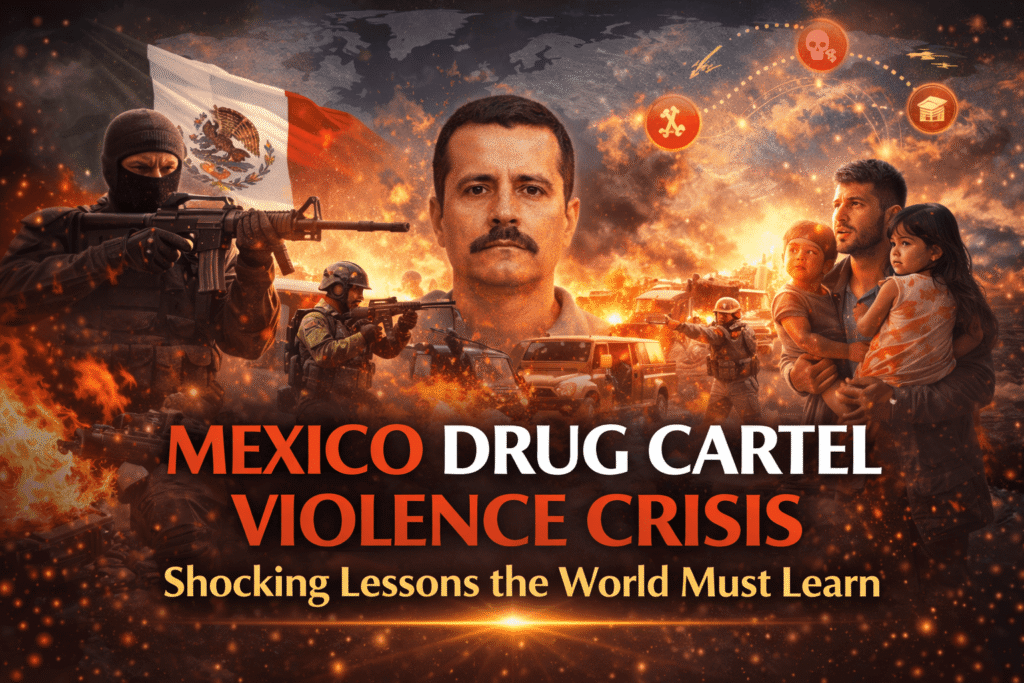
Mexico Drug Cartel Violence Crisis is not just a national issue anymore. It has become a global warning sign. In recent weeks, international media including BBC News, CNN, Al Jazeera, and The Guardian reported on major developments in Mexico, including military operations against powerful drug cartels. One of the biggest headlines was about the killing of the feared cartel leader known as El Mencho.
But the real story is bigger than one man. The Mexico Drug Cartel Violence Crisis shows how organized crime, corruption, poverty, and international demand for drugs combine to create long-term instability. This article explains what is happening, why it is happening, who El Mencho was, and what the entire world must learn from Mexico’s experience.
What Is Happening in Mexico Right Now
Mexico has been fighting drug cartels for more than two decades. But the violence has not ended. Instead, it has changed form.
Recently, the Mexican government announced a major military operation targeting a top cartel leader. Reports suggested that El Mencho, one of the most wanted criminals in the world, was killed during a security operation. After this news, violence spread across several Mexican states. There were road blockades, burning vehicles, gunfights, and fear among civilians.
The Mexico Drug Cartel Violence Crisis became more intense because whenever a cartel leader is removed, smaller groups fight to control territory. This creates power struggles. Ordinary citizens suffer the most.
Many international governments even issued travel warnings for certain regions of Mexico. This shows how serious the situation has become.
Who Was El Mencho?
El Mencho was the nickname of Nemesio Oseguera Cervantes. He was the leader of the powerful Jalisco New Generation Cartel, often called CJNG. Under his leadership, the cartel expanded rapidly and became one of the most violent criminal organizations in Mexico.
El Mencho started from a small criminal background but built a massive drug trafficking network. His cartel was involved in producing and exporting drugs like methamphetamine and fentanyl to the United States and other countries. Authorities accused him of extreme violence, including attacks on police and military forces.
The United States government had placed a reward of millions of dollars for information leading to his capture. He was seen as one of the most dangerous drug traffickers in the world.
However, removing a leader like El Mencho does not automatically end the Mexico Drug Cartel Violence Crisis. Sometimes it even creates more chaos because new leaders compete for control.
Why Is This Violence Happening?
The Mexico Drug Cartel Violence Crisis did not start overnight. It has deep roots.
One major reason is global drug demand. Countries like the United States are large markets for illegal drugs. As long as demand remains high, supply networks will exist.
Another reason is poverty and lack of opportunity in certain regions of Mexico. Many young people join cartels because they see no other economic option. Cartels offer money, power, and protection.
Corruption is also a serious issue. In some cases, local officials have been accused of helping criminal groups. This weakens trust in the system.
Geography plays a role too. Mexico is located between South America, where many drugs are produced, and the United States, one of the largest consumers. This makes Mexico a key transit route.
All these factors together fuel the Mexico Drug Cartel Violence Crisis.
Impact on Ordinary People
When media reports talk about cartel violence, they often focus on big names and dramatic operations. But the real victims are common citizens.
Families are forced to leave their homes. Businesses close early due to fear. Children grow up in areas where gunfire is not rare.
Tourism also suffers. Some regions of Mexico depend heavily on tourism. When travel warnings are issued, local economies are affected.
The Mexico Drug Cartel Violence Crisis is not only about crime statistics. It is about daily life being disturbed.
Government Response and Its Challenges
The Mexican government has tried different strategies over the years. Some presidents focused on military action. Others tried social programs.
Military operations can weaken cartels in the short term. But they can also lead to violent reactions. Arresting or killing a top leader sometimes causes fragmentation. Smaller gangs break away and fight each other.
Long-term solutions require better education, employment opportunities, police reform, and international cooperation.
The Mexico Drug Cartel Violence Crisis shows that force alone is not enough.
International Dimension of the Crisis
This crisis is not limited to Mexico’s borders.
Drug trafficking routes connect multiple countries. Weapons often flow from outside Mexico into cartel hands. Money is laundered through international systems.
Countries like the United States have worked with Mexico on security cooperation. However, tensions sometimes arise over responsibility.
The Mexico Drug Cartel Violence Crisis teaches the world that organized crime is global. No country can solve it alone.
Media Coverage and Global Attention
Major global media outlets such as CNN and BBC News regularly cover cartel developments. When a major figure like El Mencho is targeted, it becomes international news.
This global attention increases pressure on governments to act. But it also shows how interconnected the world is.
What happens in one country can influence security discussions worldwide.
What the World Must Learn from Mexico
The Mexico Drug Cartel Violence Crisis is a warning.
First, ignoring early signs of organized crime allows it to grow stronger. Prevention is always better than reaction.
Second, youth unemployment and social inequality create fertile ground for criminal recruitment. Investing in education and local development is critical.
Third, international cooperation is essential. Drug demand in one country fuels violence in another.
Fourth, corruption must be addressed honestly. Without trust in institutions, reforms fail.
Countries in Latin America, Asia, Africa, and even Europe can learn from Mexico’s struggle. Organized crime networks are flexible. If systems are weak, they expand.
Can the Situation Improve?
Yes, but slowly.
Mexico has strong institutions, civil society organizations, journalists, and activists who continue to push for reform. Many communities are working toward peace.
Reducing violence requires balanced policies. Law enforcement must be strong but accountable. Social investment must reach vulnerable communities.
The Mexico Drug Cartel Violence Crisis will not disappear in a year. But with consistent effort, improvement is possible.
Final Thoughts: A Global Reflection
The Mexico Drug Cartel Violence Crisis is not just about El Mencho. It is about systems, society, and global responsibility.
If the world only watches and does nothing, similar crises can grow elsewhere.
For Vishwalens readers, the key message is simple: crime grows where opportunity shrinks and corruption spreads. Mexico’s experience reminds us that security, justice, and development must move together.
The lesson is clear. Strong governance, economic opportunity, and international cooperation are not optional. They are necessary.
The Mexico Drug Cartel Violence Crisis is painful, but it offers powerful lessons. The world should pay attention before it is too late.
Frequently Asked Questions (FAQ)
What is the Mexico Drug Cartel Violence Crisis?
The Mexico Drug Cartel Violence Crisis refers to the ongoing conflict between powerful drug cartels and Mexican security forces. It includes territorial fights, illegal drug trafficking, organized crime, and its impact on civilians and national stability.
Why did violence increase after the operation against El Mencho?
When a major cartel leader like Nemesio Oseguera Cervantes (El Mencho) is removed, power struggles often begin inside the organization. Smaller groups compete for control, which can temporarily increase violence.
Who was El Mencho?
El Mencho was the leader of the Jalisco New Generation Cartel (CJNG). He was considered one of the most powerful and dangerous drug traffickers in the world and was wanted by international authorities.
Is the crisis only Mexico’s responsibility?
No. The crisis has international dimensions. Drug demand, illegal arms flow, and money laundering networks connect multiple countries. Many experts believe global cooperation is necessary to reduce organized crime.
How does cartel violence affect ordinary citizens?
Cartel violence can disrupt daily life, damage local businesses, create fear, and force families to relocate. Tourism and local economies may also suffer during periods of instability.
What lessons can other countries learn from this crisis?
Countries can learn the importance of early prevention, strong institutions, anti-corruption efforts, youth employment programs, and international cooperation to stop organized crime before it grows.
Can the situation improve in the future?
Yes, improvement is possible through balanced policies that combine law enforcement, social development programs, transparency, and global collaboration.