
What Global Approaches Teach Us About Governance, Society, and Citizens
global problems and solutions – When we think about the concept of the world, we often imagine humanity spread across the entire planet. Viewed this way alone, the idea remains abstract and idealistic. When we look deeper, however, we see a world divided into countries by borders. In today’s reality, the world can be understood as a collection of different nations, each shaped by its own history, culture, values, and systems.
Countries across the globe differ in ethics, thinking patterns, traditions, and social norms. Yet despite these differences, many of the problems they face are strikingly similar. Rising inflation, unemployment, pressure on education systems, healthcare access, public safety concerns, and climate change affect nations in comparable ways. These shared challenges raise an important question: when solving global problems, should countries think only within national boundaries, or should they also learn from one another?
There are no perfect system and no universal model that eliminates problems entirely. Every country experiment, learns from experience, corrects mistakes, and refines its policies over time. By examining how different nations respond to similar challenges, global citizens can gain valuable insights into what works, what fails, and why.
Common Global Problems in the Modern World
Despite differences in culture, politics, and economic structure, countries worldwide grapple with common challenges. Providing affordable healthcare, preparing young people for a rapidly changing world, reducing inequality, balancing freedom with security, responding to climate change, and maintaining trust in democratic institutions are questions faced everywhere.
Globalization, technology, migration, and environmental change have interconnected these issues. Economic crises in one region affect markets elsewhere. Health emergencies cross borders quickly. Climate change impacts every nation, regardless of geography. While the problems are shared, the solutions vary significantly.
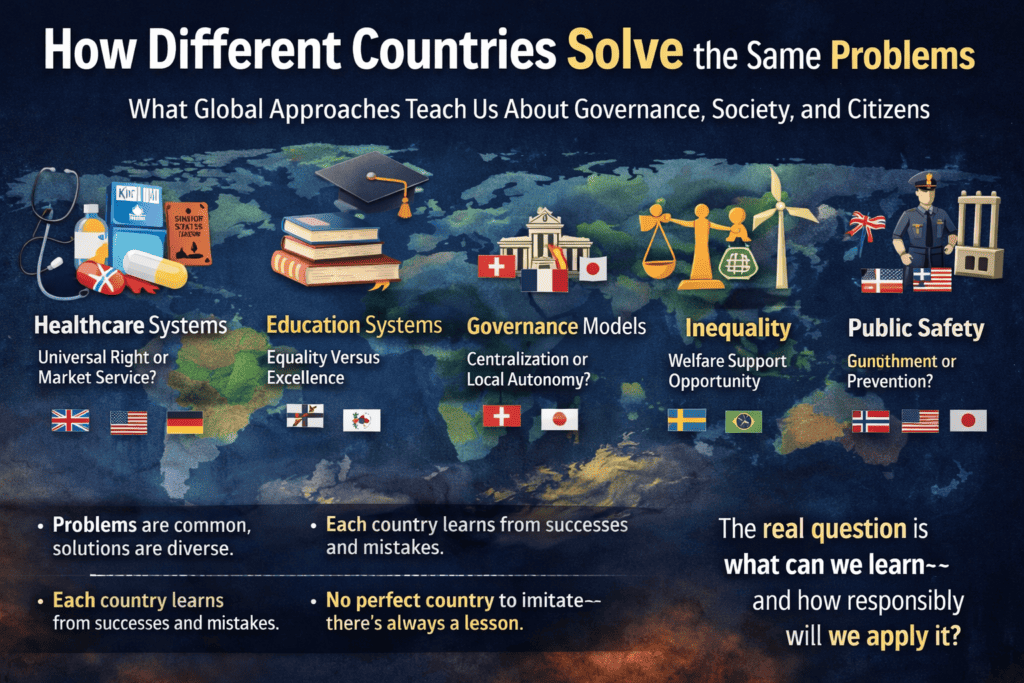
Healthcare Systems: Universal Right or Market Service?
The shared goal of healthcare systems is healthy citizens, but the methods differ widely.
In the United Kingdom, healthcare is treated as a public service. The National Health Service (NHS), funded by taxes, provides medical care to all citizens. While universal access is prioritized, long waiting times and funding pressures remain challenges.
The United States follows a largely market-driven healthcare model. Medical innovation is advanced, but high costs and unequal access persist due to insurance- and income-based coverage.
Germany represents a mixed healthcare system, combining mandatory insurance, public regulation, and private providers. Citizens have choices, while the government ensures universal coverage.
These models demonstrate that no healthcare system is flawless. Universal systems promote access, market systems encourage innovation, and successful approaches aim to balance equity, efficiency, and sustainability.
Education Systems: Equality Versus Excellence
Education reflects the values of society.
Finland emphasizes equality over competition, with fewer standardized exams, highly trained teachers, and strong public trust. Education is viewed as a collective social responsibility.
South Korea focuses on discipline, performance, and examination results. While academic outcomes are strong, students often face intense pressure and mental health challenges.
India struggles with both scale and quality. Although elite institutions produce global talent, access to high-quality education remains uneven. This highlights a crucial question: education is not only about academic achievement, but also about shaping responsible, capable citizens.
Governance Models: Centralization or Local Autonomy?
Governance structures shape how policies are made and implemented.
Switzerland practices direct democracy, allowing citizens to vote frequently on policy decisions. Participation is high, though decision-making can be slow.
France relies on a strong centralized government. Policies are consistent and efficient but sometimes disconnected from local realities.
Japan balances bureaucratic efficiency with social cooperation, resulting in consistent policy implementation.
These examples show that effective governance depends not only on authority, but also on trust, legitimacy, and accountability.
Inequality: Welfare Support or Opportunity Creation?
Nordic countries address inequality through high taxation that funds welfare, education, and healthcare. This approach reduces inequality and promotes social mobility.
Singapore prioritizes opportunity over direct welfare. Strong housing, education, and employment policies help keep poverty low without extensive redistribution.
Brazil combines welfare programs with economic reforms, but faces challenges related to corruption and implementation.
Reducing inequality requires both social safety nets and fair opportunities. Without transparency and trust, even well-designed policies struggle to succeed.
Climate Change: Economic Growth or Environmental Responsibility?
Germany invested early in renewable energy. Although initial costs were high, the long-term benefits have strengthened sustainability and public awareness.
China leads in renewable energy production but still relies heavily on coal. The country seeks a gradual balance between development and environmental responsibility.
For small island nations, climate change is an existential threat. Their policies focus on adaptation, global advocacy, and survival.
Climate solutions depend on economic capacity, political commitment, and public pressure. Delayed action increases long-term costs for all.
Public Safety: Punishment or Prevention?
Norway emphasizes rehabilitation in its prison system, offering humane conditions and achieving low reoffending rates.
The United States relies on punitive measures and long sentences, resulting in mass incarceration without proportional reductions in crime.
Japan focuses on social discipline, early intervention, and community responsibility, leading to consistently low crime rates.
Public safety improves most effectively when societies address root causes rather than relying solely on punishment.
Media and Information: Freedom Versus Responsibility
Germany enforces strict laws against hate speech and misinformation while maintaining press freedom.
The United States offers broad free speech protections, but misinformation spreads rapidly and widely.
India’s diverse media environment faces challenges of polarization, political pressure, and declining trust.
A healthy information system requires media literacy, ethical journalism, and informed citizens.
What Global Comparisons Teach Us
Studying other countries does not mean copying them blindly. Cultural context, history, institutions, and demographics shape outcomes. However, global comparisons help societies ask better questions: why did a policy succeed there, what conditions enabled it, and which mistakes should be avoided?
This approach shifts public debate from ideology to evidence.
The Role of Citizens in Every System
No system functions effectively without citizen participation. Policies fail without trust, democracies weaken when citizens disengage, and welfare systems collapse without accountability. Across nations, the strongest societies share one trait: active, informed, and responsible citizens.
Why a Global Perspective Matters Today
In an age of instant reactions and outrage, a global perspective encourages reflection. It reminds us that complex problems require time, patience, and thoughtful solutions. Understanding how different countries address similar challenges helps societies respond with insight rather than emotion.
Conclusion: Learning Without Imitation
No country offers a perfect model, and no system provides final answers. Yet valuable lessons exist everywhere. Looking beyond borders fosters humility, helps policymakers avoid repeated mistakes, and enables societies to combine global understanding with local wisdom.
Ultimately, the question is not “Which country is the best?”
The real question is what can we learn—and how responsibly will we apply it?
FAQ 1: What is the main idea of this article?
Answer:
The article explores how different countries face similar global problems but adopt different solutions based on their culture, governance, and social values. It highlights lessons that citizens and policymakers can learn from global comparisons.
FAQ 2: Why do different countries have different solutions to the same problems?
Answer:
Countries differ in history, culture, economic capacity, political systems, and social values. These factors shape how policies are designed and implemented, even when the underlying problems are similar.
FAQ 3: What common problems do countries face globally?
Answer:
Common global problems include healthcare access, education quality, inequality, governance challenges, climate change, public safety, and misinformation in media.
FAQ 4: Is there a perfect model for solving global problems?
Answer:
No, there is no perfect or universal model. Every system has strengths and weaknesses. Successful countries continuously experiment, learn from mistakes, and adapt their policies over time.
FAQ 5: What can countries learn from global comparisons?
Answer:
Global comparisons help countries understand what works, what fails, and why. They encourage evidence-based decision-making instead of ideological debates and help avoid repeating known mistakes.
FAQ 6: How do healthcare systems differ across countries?
Answer:
Some countries treat healthcare as a universal public service, others rely on market-based systems, and many use mixed models. Each approach balances access, cost, and innovation differently.
FAQ 7: What role do citizens play in successful systems?
Answer:
Active, informed, and responsible citizens are essential. Without public trust, participation, and accountability, even the best-designed policies and systems fail.
FAQ 8: Why is a global perspective important today?
Answer:
A global perspective helps societies move beyond quick reactions and emotional responses. It encourages reflection, patience, and thoughtful solutions to complex, interconnected problems.
FAQ 9: Does the article suggest copying other countries’ models?
Answer:
No. The article emphasizes learning from other countries, not blindly copying them. Solutions must be adapted to local contexts, values, and realities.
FAQ 10: What is the key takeaway from this article?
Answer:
The key takeaway is that progress comes from learning responsibly—combining global insights with local wisdom to address shared challenges effectively.