
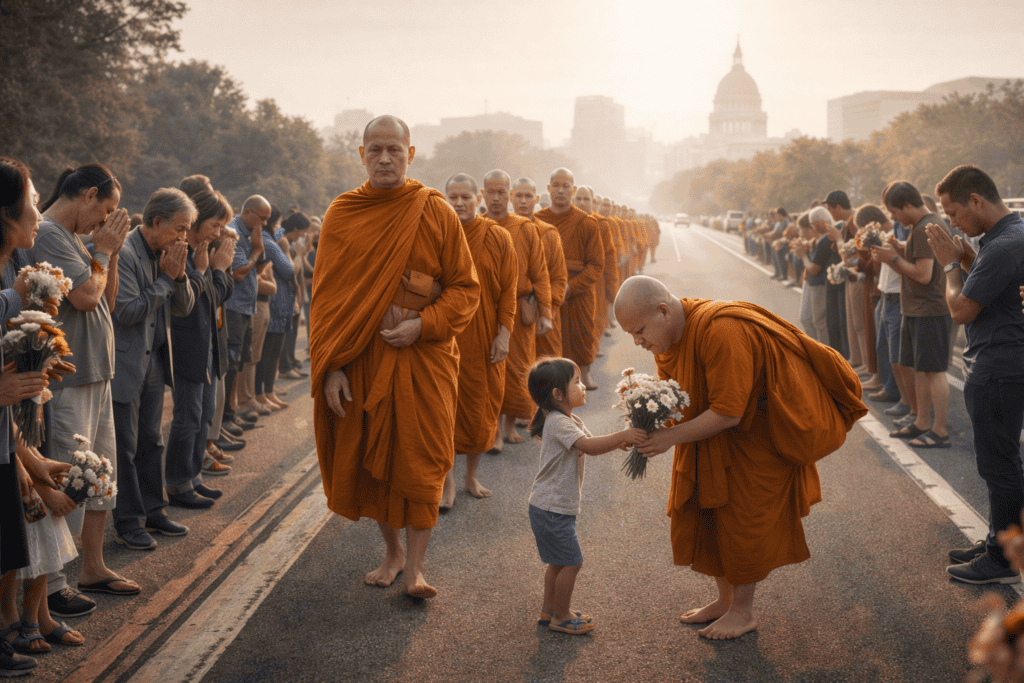
Introduction: A Quiet Image That Speaks Loudly
While scrolling through social media, many people recently paused at an unusual sight. A group of Buddhist monks walking barefoot on American roads, moving slowly, calmly, and silently through busy cities and small towns.
There were no banners, no slogans, no angry chants. Yet people stopped, gathered, smiled, cried, and bowed in respect.
This is not a protest.
This is not a political movement.
This is the Buddhist Walk for Peace in America — a journey that reminds people of something deeply human that modern life often forgets: peace begins within.
What Is the Buddhist Walk for Peace in America?
The Buddhist Walk for Peace in America is a long spiritual pilgrimage undertaken by a group of Buddhist monks with one clear intention — to awaken compassion, non-violence, and mindfulness in society.
This walk is not against any government, religion, or ideology. Instead, it is a peaceful invitation for people to pause, reflect, and reconnect with their inner humanity.
Covering nearly 2,300 miles, the monks are walking from Texas to Washington, D.C., passing through multiple states and communities. Every step is deliberate. Every mile is a message.
The Journey: From Texas to the Heart of the Nation
The walk began on October 26 at a Vietnamese Buddhist temple in Fort Worth, Texas. From there, the monks passed through states including:
- Louisiana
- Mississippi
- Alabama
- Georgia
- South Carolina
- North Carolina
In each state, they stopped at capital cities, engaging in meditation, silent prayer, and gentle interaction with local communities.
Wherever they went, the response was similar: curiosity turned into respect, and respect often turned into emotion.
Leadership and Sacrifice: Walking Barefoot for Humanity
The walk is led by Venerable Bhikkhu Pannakara, who is walking barefoot throughout the entire journey.
Walking barefoot is not symbolic alone — it is deeply physical. The monks have faced glass shards, sharp stones, nails, extreme weather, and exhaustion. Their feet are bandaged daily. Still, they continue.
According to Bhikkhu Pannakara, this suffering is not personal.
It is a way of understanding the pain carried silently by humanity.
Dhutanga Practice: Discipline Beyond Comfort
Two monks on the journey follow a strict Buddhist discipline known as Dhutanga.
Under this practice:
- They may only walk, stand, or sit
- They never lie down — even while resting
- Sleep happens in a seated meditation posture
This discipline is not about endurance for display. It is about dissolving ego, attachment, and comfort — to remain fully aware in every moment.
When Tragedy Struck — and the Walk Continued
Three weeks into the journey, tragedy struck.
A truck hit the safety vehicle accompanying the monks, injuring two of them. One monk suffered injuries so severe that his leg had to be amputated.
Despite this devastating moment, the walk did not end.
The injured monk requested that the journey continue — believing that peace must not stop because of suffering. The remaining monks honored his wish and continued forward.
This decision deeply moved people across social media and local communities.
Aloka: A Dog Who Became a Symbol of Compassion
One of the most touching parts of the Buddhist Walk for Peace in America is Aloka, a dog adopted by Bhikkhu Pannakara during a peace walk in India in 2022.
“Aloka” means light.
During the American journey, Aloka suffered a relapse of an old injury and required surgery. After recovery, when the dog reunited with the monks, the joyful moment spread widely online.
Aloka became a reminder that compassion extends beyond humans — it includes all living beings.
Why Are People Getting Emotional?
As the monks pass through towns and cities, people often break down emotionally. Many cry without knowing exactly why.
Perhaps it is because:
- Modern life rarely allows silence
- Stress, anger, and division dominate public spaces
- Gentle presence feels unfamiliar
In Selma, Alabama, the monks prayed on the historic bridge where civil rights marchers were attacked in 1965. They offered flowers into the river — honoring past struggles with quiet dignity.
No speeches were needed. The silence spoke enough.
Why Washington, D.C.?
The final destination of the Buddhist Walk for Peace in America is Washington, D.C. — the political heart of the country.
The monks believe that reaching the heart allows the message to flow outward.
Once there, they plan to respectfully request that Vesak — the day marking the birth and enlightenment of the Buddha — be recognized as a federal holiday in the United States.
But the deeper goal goes beyond policy. It is about touching conscience, not power.
Not a Movement, Not a Conversion
The monks repeatedly emphasize:
- This walk is not about religious conversion
- It is not about opposing any belief
- It is not about politics
It is about reminding people of values they already carry — compassion, restraint, and awareness.
In a divided world, this walk quietly stitches humanity back together.
A Global Message for a Divided World
Across nations, societies are becoming more polarized. Loud voices dominate. Calm reflection disappears.
The Buddhist Walk for Peace in America offers a different model:
- Change without anger
- Protest without hostility
- Faith without force
It shows that sometimes, walking slowly can move society forward more effectively than shouting.
Conclusion: A Journey That Walks Inside Us
This is not just a story of monks walking on roads.
It is a journey walking through human hearts.
In a world rushing toward noise, these monks walk in silence.
In a world driven by speed, they move deliberately.
In a world divided by belief, they speak the language of humanity.
The walk leaves us with a simple question —
Can we slow down enough to rediscover peace within ourselves?
FAQ – Buddhist Walk for Peace in America
Q1. What is the Buddhist Walk for Peace in America?
It is a spiritual peace pilgrimage where Buddhist monks walk barefoot across the U.S. to promote compassion, non-violence, and inner awareness.
Q2. Is this walk a protest or political movement?
No. It is not a protest or political campaign. It is a peaceful, spiritual initiative focused on human values.
Q3. How long is the walk?
The journey covers approximately 2,300 miles from Texas to Washington, D.C.
Q4. Why do some monks walk barefoot?
Barefoot walking is a form of spiritual discipline symbolizing humility, endurance, and connection with suffering.
Q5. What happened during the accident?
A road accident injured two monks, and one lost his leg. Despite this, the walk continued as a message of resilience.
Q6. Who is Aloka?
Aloka is a dog adopted during a peace walk in India and became a symbol of compassion during the American journey.
Q7. Why are people emotionally affected by the walk?
The monks’ silence, discipline, and calm presence contrast sharply with modern stress, making people reflect deeply.
Q8. What is the final goal of the walk?
To reach Washington, D.C., spread awareness, and request recognition of Vesak as a federal holiday.