
23 March 2026
World Happiness Report 2026
World Happiness Report 2026 was released , and it brings a clear message from global data—people’s happiness is changing fast, and not always in a positive way. The latest report, prepared by global experts from the University of Oxford and international organizations, shows that while some countries are improving, many developed nations are facing a decline in happiness, especially among youth. This report is important because it does not just talk about money or economy; it focuses on real life satisfaction—how people feel about their lives daily.
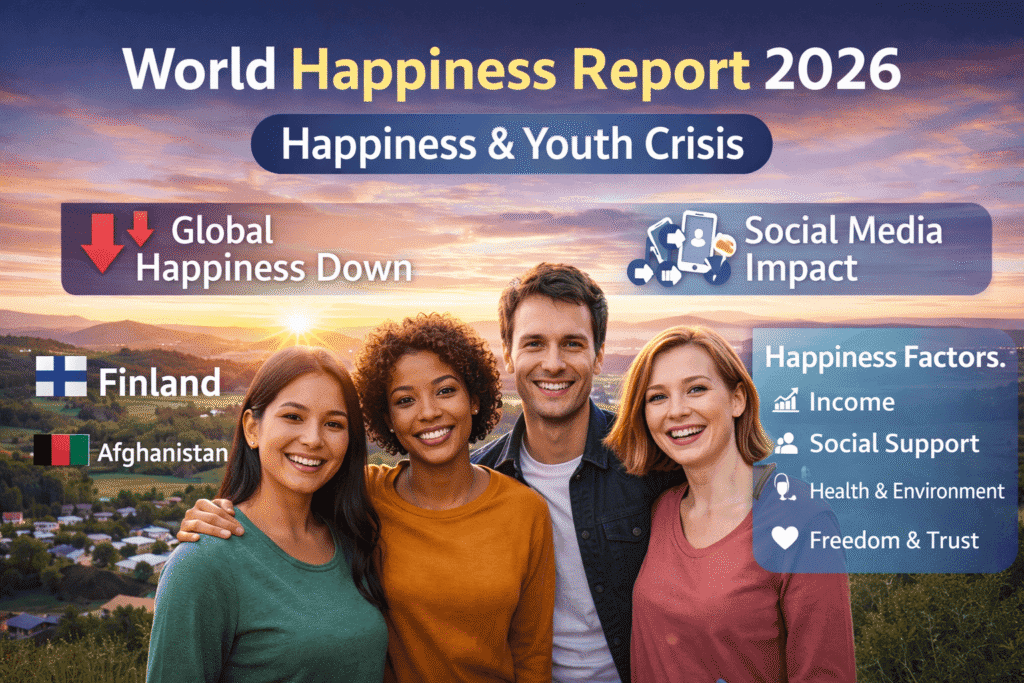
The World Happiness Report 2026 highlights that Finland continues to hold the top position as the happiest country in the world, followed by Iceland, Denmark, and Costa Rica. Nordic countries again dominate the rankings, showing strong social systems and trust in society. At the same time, countries facing conflict and instability remain at the bottom, with Afghanistan ranked lowest, showing a huge gap of more than six points between the happiest and least happy nations.
This year’s report also shows a long-term shift. Compared to earlier years, many Western countries like the United States, Canada, and Australia are seeing a drop in happiness levels. On the other side, several countries in Central and Eastern Europe are improving, showing that economic and social transitions can increase life satisfaction over time.
One of the most serious findings in the World Happiness Report 2026 is related to young people. Data shows that in many developed countries, youth happiness has declined sharply over the past decade. In fact, countries like the United States and Canada are now among the lowest when it comes to improvements in youth wellbeing. This is a big concern because young generations represent the future, and their mental wellbeing directly affects long-term social stability.
Experts in the report point toward one major factor—social media and internet usage. The report clearly says that while the internet can help in communication and learning, excessive use, especially social media, is linked to lower happiness levels. For example, high exposure to social media often leads to comparison, loneliness, and reduced real-life interaction. This effect is strongest in Gen Z, where heavy internet usage shows a negative impact on mental health.
At the same time, the report does not completely blame technology. It explains that the impact depends on how people use it. When used for communication and learning, it can improve wellbeing. But when used for endless scrolling or comparison, it reduces happiness. This balanced view is important for policymakers and families.
The World Happiness Report 2026 also explains what actually makes people happy. It is not just money. The report highlights six key factors: income (GDP per capita), social support, healthy life expectancy, freedom to make life choices, generosity, and low corruption. These factors together explain most of the differences in happiness across countries. Among them, social support—having someone to rely on—is one of the most powerful drivers.
Another important update in the report is about emotional trends. It shows that negative emotions like worry and stress are increasing globally, even though positive emotions are still more frequent. This means that people are experiencing more pressure in daily life, even in countries with higher income levels.
From a ground-level perspective, this report gives a clear message for governments and society. Economic growth alone is not enough. Countries that focus on community support, trust, and mental wellbeing are performing better in happiness rankings. Nordic countries are a strong example of this approach.
There is also a regional pattern visible. Latin American countries perform better than expected in happiness, even with lower income levels. This is mainly because of strong social connections and cultural bonding. This shows that “khushi sirf paisa se nahi aati”—real happiness depends on relationships and social life.
Another key point from the World Happiness Report 2026 is inequality. The gap between the happiest and least happy countries is still very large. This gap reflects differences in governance, safety, and basic living conditions. Countries affected by war and instability continue to struggle the most.
Experts involved in the report suggest that governments should invest more in mental health support, education, and community-building programs. Schools, families, and local communities play a big role in improving happiness, especially for youth. Policies that reduce social isolation and improve trust can make a big difference.
In conclusion, the World Happiness Report 2026 is not just a ranking list—it is a reality check for the world. It clearly shows that while some countries are moving forward, others are facing serious challenges, especially in youth wellbeing and mental health. The report reminds us that happiness is not just about wealth but about balance—strong relationships, trust, freedom, and a healthy lifestyle.
For countries like India and others developing fast, this report gives an important lesson: development should be balanced with human wellbeing. Only then real progress can be achieved.