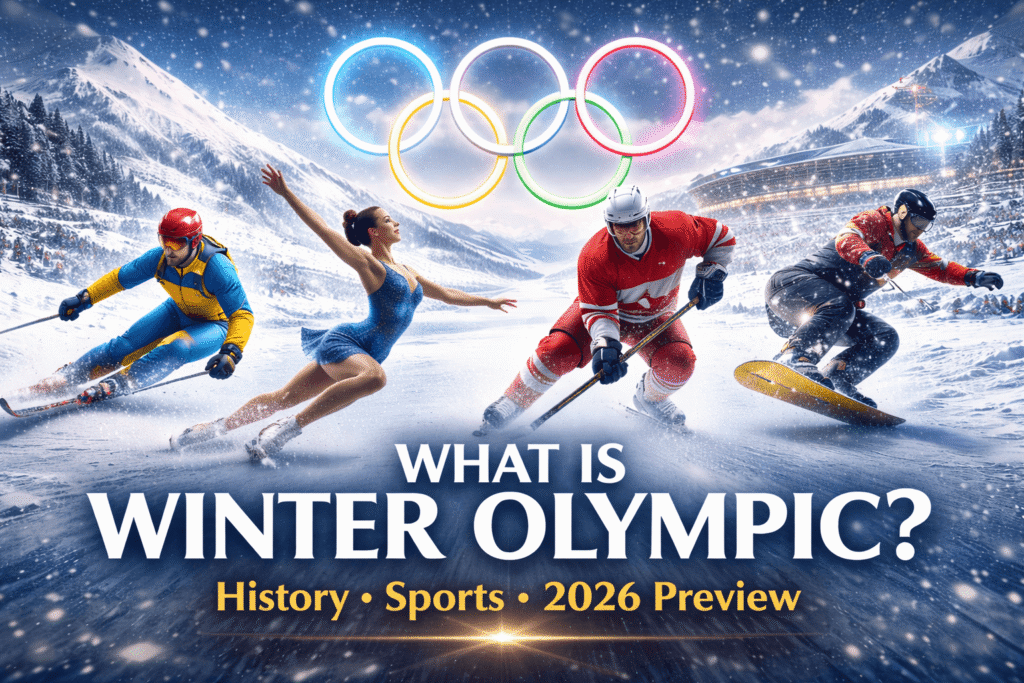
What is Winter Olympic? This is one of the most common questions people ask when they see athletes skiing down mountains at breathtaking speed or performing graceful spins on ice. The Winter Olympic Games are an international multi-sport event focused on sports played on snow and ice. They are organized by the International Olympic Committee (IOC) and held once every four years.
But honestly, the Winter Olympics are much more than a sports event. They represent unity, resilience, climate awareness, innovation, and human courage. From small snow-covered towns in Europe to massive modern cities in Asia, the Winter Games connect nations through competition and cooperation.
Let’s explore everything in depth — from its origin to the upcoming 2026 edition.
What Is Winter Olympic in Simple Words?
In simple language, what is winter olympic can be explained like this:
It is a global sports festival where athletes compete in snow and ice-based sports such as skiing, ice hockey, figure skating, and snowboarding.
Unlike the Summer Olympics, which focus on athletics, swimming, and gymnastics, the Winter Olympics are specially designed for cold-weather sports. These games require freezing temperatures, snow-covered mountains, and ice rinks — either natural or artificial.
Today, even countries without heavy snowfall participate thanks to advanced technology that creates artificial snow and indoor ice facilities.
The Historical Origins: How It All Began
To truly understand what is winter olympic, we must look back in time.
The first official Winter Olympic Games were held in 1924 in Chamonix, France. Initially, the event was called “International Winter Sports Week.” Later, it was officially recognized as the first Winter Olympics.
At that time:
- Only 16 nations participated
- Around 250 athletes competed
- Most participants were from Europe and North America
Over the decades, the event grew rapidly. However, the 1940 and 1944 Games were canceled due to World War II. After the war, the Olympics resumed and became a symbol of rebuilding and peace.
Since 1994, the Winter Olympics and Summer Olympics have been held in separate even-numbered years, two years apart. This helped increase global attention and sponsorship for both events.
Why Was the Winter Olympic Created?
The creation of the Winter Olympics was strongly influenced by Northern European countries like Norway, Sweden, and Finland, where winter sports were already deeply rooted in culture.
In the late 19th and early 20th centuries:
- Skiing was a national tradition in Scandinavia
- Ice skating competitions were popular
- Snow-based military training was common
There was a growing demand to recognize winter sports at the same international level as summer sports.
So the IOC decided to create a dedicated winter edition. The purpose was clear:
- To promote snow and ice sports globally
- To encourage international competition
- To strengthen peace through sports
- To celebrate athletic diversity
And honestly, it worked.
What Sports Are Included in the Winter Olympics?
Understanding what is winter olympic also means understanding its sports categories.
The Winter Games currently include over 15 sports disciplines. Some of the major ones are:
Alpine Skiing
Athletes race down steep mountain slopes at very high speeds. It requires balance, control, and bravery.
Figure Skating
A combination of dance, athletic jumps, and artistic performance on ice. It is one of the most watched events globally.
Ice Hockey
A fast-paced team sport played on ice. Countries like Canada, USA, and Russia dominate historically.
Snowboarding
Athletes perform tricks and race on snow using a snowboard instead of skis.
Biathlon
A unique sport that combines cross-country skiing and rifle shooting.
Bobsleigh and Luge
Teams or individuals slide down icy tracks in specially designed sleds at extreme speeds.
Each sport demands precision, courage, and technical skill.
Global Importance of the Winter Olympic
When we ask what is winter olympic, we must also look at its global impact.
1. Promoting International Unity
Athletes from over 90 countries compete together. Political tensions often pause during the Games.
2. Economic Boost
Host cities experience tourism growth, infrastructure development, and global branding opportunities.
3. Cultural Exchange
Opening and closing ceremonies showcase national identity and culture.
4. Technological Advancement
Snow-making systems, eco-stadiums, and broadcast technology improve with each edition.
Environmental Challenges in Modern Times
Today, the Winter Olympics face serious climate challenges.
Climate change has reduced natural snowfall in many traditional winter regions. Some host cities now rely heavily on artificial snow. This increases water usage and energy consumption.
Because of this, sustainability has become a key focus. Recent Olympic bids emphasize:
- Reusing existing venues
- Renewable energy use
- Carbon-neutral planning
- Reduced construction
The IOC now strongly encourages environmentally responsible hosting.
Winter Olympic 2026: What to Expect
The upcoming Winter Olympic Games in 2026 will be hosted by Milan and Cortina d’Ampezzo in Italy.
Event Dates: 6 February – 22 February 2026
This will mark Italy’s return as host after the 1956 Games in Cortina.
The 2026 edition promises:
- Sustainable infrastructure
- Use of existing Alpine venues
- Enhanced athlete facilities
- Greater European audience engagement
Many experts believe this edition will set a new benchmark for eco-friendly winter sporting events.
How Countries Prepare for the Winter Olympics
Preparation takes years — sometimes even a decade.
Countries invest in:
- National training centers
- High-altitude conditioning
- Sports science research
- Youth development programs
Nations like Norway, Germany, Canada, and the United States consistently dominate medal tables because of strong winter sports systems.
However, new countries like South Korea and China have also made impressive progress.
What Makes the Winter Olympics Unique?
Compared to the Summer Games, winter sports often involve higher risk. Athletes compete at extreme speeds and freezing temperatures.
Also:
- Events depend heavily on weather
- Equipment technology plays a crucial role
- Smaller nations can still win medals
There is something raw and intense about winter sports. You can literally see athletes fighting nature itself.
The Symbolism Behind the Games
The Olympic Rings represent five continents united through sport. In winter settings, that symbolism feels even stronger.
Cold weather sports often require teamwork, trust, and mental strength. Many athletes train in isolation for years just to compete for a few minutes.
The Games remind the world that discipline and dedication cross all borders.
Media, Broadcasting & Global Reach
Today, billions of viewers watch the Winter Olympics across digital platforms and television.
Modern broadcasting includes:
- 4K and VR streaming
- Real-time analytics
- Athlete tracking systems
- Global social media engagement
This global reach helps spread winter sports culture to regions where snow is rare.
The Future of the Winter Olympic
The future depends heavily on climate sustainability and innovation.
Experts suggest:
- Rotating Games between permanent winter hubs
- Reducing new construction
- Expanding youth winter programs
- Embracing green energy
If properly managed, the Winter Olympics can remain relevant for decades to come.
Final Thoughts: What Is Winter Olympic Really About?
So, what is winter olympic at its core?
It is not just about medals or competition. It is about courage in freezing temperatures, global cooperation, and pushing human limits on snow and ice.
From its humble beginnings in Chamonix to the upcoming 2026 Games in Milan and Cortina, the Winter Olympics have evolved into a powerful global event.
It teaches us resilience. It teaches us unity. And honestly, it reminds us that even in the coldest conditions, human spirit can shine brightly.
The next time someone asks you, “what is winter olympic?” — you won’t just give a definition. You’ll tell a story.
Frequently Asked Questions (FAQs)
1. What is Winter Olympic?
The Winter Olympic Games are an international multi-sport event held every four years featuring snow and ice sports, organized by the International Olympic Committee (IOC).
2. When did the first Winter Olympic take place?
The first Winter Olympic Games were held in 1924 in Chamonix, France.
3. How often are the Winter Olympic Games held?
The Winter Olympic Games are held once every four years, two years apart from the Summer Olympics cycle.
4. What sports are included in the Winter Olympics?
Major sports include Alpine Skiing, Figure Skating, Ice Hockey, Snowboarding, Biathlon, Bobsleigh, and Luge.
5. Who organizes the Winter Olympic Games?
The Games are organized and governed by the International Olympic Committee (IOC).
6. Where will the Winter Olympic 2026 be held?
The 2026 Winter Olympic Games will be hosted by Milan and Cortina d’Ampezzo, Italy.
7. Why are the Winter Olympics important globally?
They promote international unity, sportsmanship, cultural exchange, economic development, and technological innovation.