Introduction- Social Issues in Modern Society
In many societies today, we often notice something strange. As a human species, we are more advanced than ever before. We have powerful technology, instant communication, scientific progress, and comforts that earlier generations could not even imagine. And yet, when we look around us carefully, a simple question quietly appears—have we really built a society where people live with dignity, fairness, and contentment?
From everyday observations, it becomes clear that development has not automatically created a humane society. Many people still struggle for basic needs. Justice feels distant. Equality remains uneven. While the human race has evolved rapidly, human society still feels incomplete, uncertain, and deeply divided.
Social issues in modern society are not sudden problems. They have grown slowly, often hidden behind progress, speed, and convenience. This article reflects on some of the most important challenges modern society faces today—not to blame, but to understand.
The Idea of Progress and the Reality of Society
Modern society proudly speaks about growth, innovation, and achievement. But progress is not only about buildings, machines, or economic numbers. It is also about human relationships, mental well-being, and fairness.
When development moves faster than human understanding, gaps begin to appear. People feel disconnected. Communities weaken. Empathy becomes rare. Social issues in modern society often begin where human values fail to keep pace with material success.
Climate Change and the Environment: A Shared Responsibility
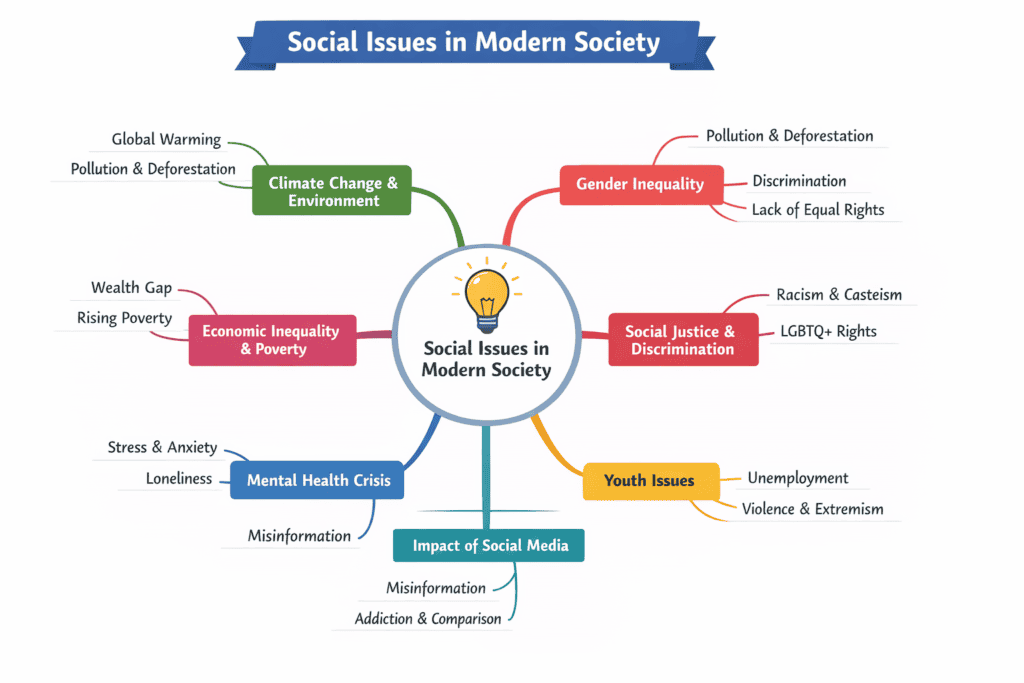
One of the most urgent issues facing modern society is climate change and environmental damage. Humans often behave as if they are separate from nature, rather than a part of it. In the race for development, forests disappear, rivers suffer, and air becomes polluted.
Today, the consequences are visible everywhere—unpredictable weather, rising temperatures, melting ice, floods, droughts, and natural disasters. These are not distant problems. They affect daily life, food security, health, and future generations.
Climate action is no longer optional. It is a social responsibility. Ignoring environmental balance means risking human survival itself.
Economic Inequality and Poverty
Economic growth is often celebrated as a sign of success. But growth without equality creates deep divisions. In modern society, wealth is increasingly concentrated in the hands of a small group, while a large population struggles to meet basic needs.
Poverty is not limited to one region or continent. Even in developed nations, many people live paycheck to paycheck. In several parts of the world, especially in developing regions, poverty continues across generations.
This growing gap creates frustration, social tension, and conflict. When opportunities are unequal, society slowly loses trust in fairness and justice.
Gender Inequality: A Continuing Struggle
Despite progress, gender inequality remains one of the most painful social issues in modern society. In many cultures, women still face restrictions, discrimination, and violence. They are denied freedom, education, and decision-making power.
Even today, women must fight for equal pay, safety, and respect. Gender equity is not about competition between men and women—it is about dignity, opportunity, and basic human rights.
A society that limits half of its population cannot truly call itself developed.
Social Justice and Exclusion
Many constitutions and philosophies speak about equality and justice. Yet, in practice, discrimination still exists—based on caste, race, colour, language, region, religion, or identity.
Marginalized communities, including indigenous groups and the LGBTQ+ community, continue to fight for recognition, safety, and basic rights. Hate speech, exclusion, and denial of opportunity weaken the moral foundation of society.
Social justice is not just a legal concept. It is a daily practice of fairness, inclusion, and respect.
The Changing Face of Imperialism
Traditional imperialism may have declined, but modern forms still exist. Powerful nations influence weaker countries through economic pressure, political decisions, and military dominance.
In modern society, control is often subtle. Policies, trade agreements, and financial systems shape global power structures. Conflicts and wars may have different reasons, but the underlying struggle for dominance remains the same.
This imbalance affects global peace and deepens inequality between nations.
Lack of Social Awareness
One silent but serious problem in modern society is the lack of awareness. Many people are busy surviving, earning, and scrolling. Reflection becomes rare.
Awareness does not mean activism. It means understanding. When awareness is missing, serious issues like poverty, discrimination, and environmental damage remain unsolved—not because people are cruel, but because they are distracted.
A society without awareness reacts emotionally rather than thinking responsibly.
The Impact of Social Media on Society
Social media has transformed communication. It connects people instantly, but it also shapes thinking in unhealthy ways. Misinformation spreads faster than truth. Opinions travel faster than facts.
Comparison culture affects self-worth. Attention spans shrink. Meaningful conversations are replaced by quick reactions. In daily life, many people feel pressure to appear perfect online while feeling lonely offline.
Social media is a tool. The danger lies in using it without awareness.
Mental Health: The Silent Crisis
Mental health challenges have become one of the most serious social issues in modern society. Stress, loneliness, job pressure, and constant digital exposure affect people of all ages.
Despite increasing discussion, mental health is still misunderstood. Many people suffer quietly due to stigma or lack of support. Ignoring mental well-being weakens families, workplaces, and communities.
A healthy society must value emotional health as much as physical health.
Youth: The Most Ignored Strength
Youth are often described as the future, yet their voices are frequently ignored. In many societies, young people lack guidance, opportunity, and purpose.
When youth feel neglected, frustration finds destructive paths—violence, addiction, extremism, or hopelessness. For example, rising youth stress, social media addiction, and urban loneliness are now common realities.
Youth empowerment is not about control. It is about direction, education, and trust. When guided properly, youth become builders, not destroyers.
Conclusion: A Question We Must Sit With
Social issues in modern society do not have simple solutions. They are complex, connected, and deeply human. Technology alone cannot solve them. Laws alone cannot fix them.
What modern society needs most is awareness—with patience, honesty, and responsibility.
If progress continues without reflection, we may move faster but not wiser. But if individuals choose to think, observe, and care, society can slowly heal.
The real question is not whether society can be perfect. It is whether we are willing to make it more humane—step by step, thought by thought.
And perhaps, that is where real progress begins.
❓ Frequently Asked Questions (FAQs)
1. What are the main social issues in modern society?
The main social issues in modern society include economic inequality, climate change, lack of social awareness, gender inequality, mental health challenges, youth issues, and the impact of social media. These issues affect people across countries and cultures.
2. Why are social issues in modern society increasing?
Social issues are increasing because development is often faster than human understanding. Rapid technological growth, economic imbalance, weak social awareness, and changing human relationships contribute to these problems.
3. How does social media affect modern society?
Social media connects people globally, but it also spreads misinformation, encourages comparison, and reduces attention span. In modern society, opinions often spread faster than facts, which affects critical thinking and social harmony.
4. Why is social awareness important in modern society?
Social awareness helps people understand problems beyond their personal lives. Without awareness, issues like poverty, discrimination, and environmental damage remain ignored. Awareness encourages responsible thinking, not blind reactions.
5. How does economic inequality impact society?
Economic inequality creates social tension and frustration. When wealth is concentrated among a small group, many people struggle with basic needs. This weakens trust, fairness, and long-term social stability.
6. Why is mental health a serious issue in modern society?
Mental health is a serious issue because stress, loneliness, work pressure, and digital overload affect people daily. Despite growing discussions, mental health is still misunderstood and often neglected in many societies.
7. What role does youth play in modern society?
Youth are not a problem but a powerful strength. When young people lack guidance, opportunity, and purpose, frustration grows. Youth empowerment through education and awareness is essential for healthy social development.
8. Can social issues in modern society be solved?
Social issues cannot be solved overnight. However, awareness, responsible decision-making, inclusive policies, and individual actions can gradually improve society and reduce long-term damage.
9. How can individuals help improve society?
Individuals can help by staying informed, thinking critically, avoiding misinformation, showing empathy, and making responsible daily choices. Small actions guided by awareness can create meaningful social change.
10. Why should we talk about social issues openly?
Open discussion helps society reflect and improve. Ignoring social issues allows them to grow silently, while thoughtful conversation encourages understanding, inclusion, and long-term solutions.