
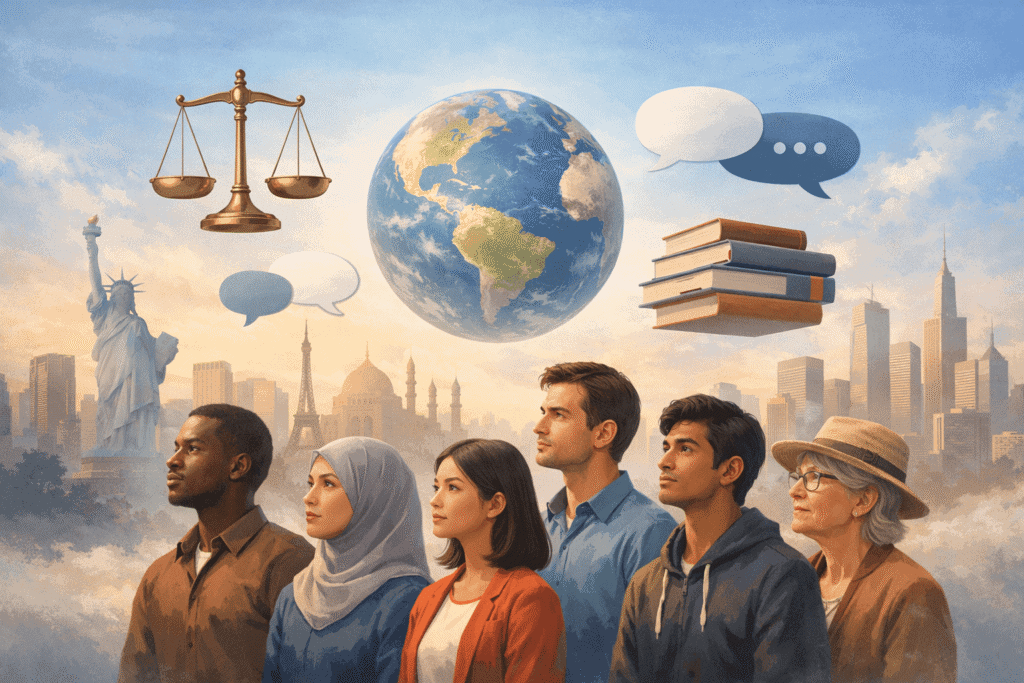
Why Civic Awareness Matters in Modern Democracies-
Introduction: The Silent Weakness of Democracies
Across the world, democracy is often measured by elections, institutions, and laws. But there is a deeper truth that many societies are slowly confronting: democracy weakens not only when institutions fail, but when citizens stop thinking critically.
From India to the United States, from Europe to emerging democracies, people speak passionately about rights. Yet, conversations about civic responsibility, awareness, and informed participation are fading. In an age flooded with information, societies are facing a paradox — people know more headlines than ever, but understand less context than before.
This raises a fundamental question:
Are we truly informed citizens, or just passive consumers of information?
The Information Age and the Crisis of Understanding
We live in an era of instant access. News travels faster than facts. Opinions form quicker than understanding. Social media platforms reward emotion over evidence and speed over reflection.
The problem is not lack of information — it is the absence of civic discernment.
Globally, this has led to:
- Rapid spread of misinformation
- Polarized societies
- Declining trust in democratic institutions
- Emotional decision-making instead of rational debate
Information without context does not empower citizens. It confuses them. When facts are not verified and narratives are not questioned, democracy becomes vulnerable — not to external enemies, but to internal neglect.
Civic awareness acts as a filter between information and belief. Without it, even free societies can drift toward chaos.
The Cost of Ignoring Fact-Checking
When citizens stop verifying information, falsehoods gain legitimacy.
Around the world, unchecked misinformation has:
- Triggered social unrest
- Deepened communal and ideological divisions
- Undermined faith in elections and governance
- Normalized hate and fear
This is not merely a media failure. It is a citizen awareness failure.
A healthy democracy requires citizens who do not blindly accept what they read or hear, but ask:
- Who is the source?
- What is the evidence?
- What is being omitted?
- Who benefits from this narrative?
Civic platforms like VishwaLens exist to encourage this habit of questioning — not to dictate conclusions, but to provide clarity.
Youth: The Greatest Democratic Strength, Yet Most Vulnerable
Globally, young people form the largest and most powerful demographic in many countries. They are digitally connected, socially expressive, and eager to participate. Yet, many lack structured civic understanding.
Today’s youth often:
- Engage actively online
- React strongly to political narratives
- Know their rights
- But remain unfamiliar with constitutional values, governance processes, and policy implications
Without critical thinking, youthful energy can be misdirected into ideological extremes or passive disengagement.
Civic awareness helps young citizens:
- Distinguish opinion from fact
- Participate responsibly
- Understand long-term consequences of political decisions
Empowered youth do not follow narratives blindly — they analyse, question, and contribute meaningfully.
Citizenship Beyond Voting
Democracy is not a one-day event held during elections. It is a continuous process that depends on everyday civic behaviour.
Being a citizen means:
- Understanding constitutional values
- Respecting diversity and disagreement
- Speaking against injustice with responsibility
- Participating beyond slogans and symbols
Globally, democracies suffer when citizens remember their rights but forget their duties. Awareness bridges this gap by turning passive voters into active participants.
Civic consciousness transforms democracy from a system into a shared responsibility.
Social Realities Demand Informed Dialogue
Issues such as gender equality, education quality, employment insecurity, environmental challenges, and digital ethics exist across borders.
Too often, these topics are reduced to:
- Emotional debates
- Political blame games
- Oversimplified narratives
Without context, solutions remain superficial.
A civic platform must approach such issues with:
- Verified data
- Historical background
- Human sensitivity
- Global comparisons
This is how societies learn — not through noise, but through nuanced understanding.
What a Civic Platform Should Be — and Should Not Be
An independent civic platform is not a political mouthpiece. It does not exist to promote power or oppose authority blindly.
A responsible platform:
- Encourages dialogue, not division
- Prioritizes public interest over popularity
- Presents facts before opinions
- Allows disagreement without hostility
VishwaLens follows this approach. It invites readers to think, not to obey. It challenges silence, not stability.
Asking the Right Questions
Unlike sensational platforms that chase trends, civic awareness platforms focus on impact.
They ask:
- How does this policy affect ordinary citizens?
- What are the long-term consequences?
- What global lessons can be learned?
- Whose voices are missing?
These questions do not weaken democracy — they strengthen it.
A Non-Violent Form of Resistance
Civic awareness is a quiet form of resistance. It does not rely on confrontation, but on consciousness.
This resistance:
- Opposes ignorance with understanding
- Counters hate with facts
- Challenges power with accountability
- Breaks silence with informed dialogue
Words, when used responsibly, can transform societies.
The Role of Civic Platforms in Society
A platform like VishwaLens aims to:
- Cultivate critical thinking
- Encourage youth engagement
- Restore dialogue culture
- Provide global context to local issues
Democracy survives not because institutions exist, but because citizens care enough to understand and protect it.
Conclusion: Awareness as the Foundation of the Future
No single platform can change society alone. But every informed citizen contributes to collective progress.
History shows one consistent truth:
When citizens become aware, change follows.
VishwaLens exists for those who refuse to remain silent spectators —
For those who question responsibly,
Think independently,
And believe that democracy is not inherited, but practiced.